Why the 2 A.M. Walk to the Bathroom Keeps So Many Families Up at Night — and the Simple $49 “Senior Helper” Kit That Lights the Way, Calls for Help, and Helps Mom Stay in Her Own Home
No monthly fees. No installer. No complicated tech. Just a handful of small, smart, inexpensive tools that tackle the moments that worry families most: the dark hallway, the slippery floor, and the help that’s just one room away but can’t hear you.
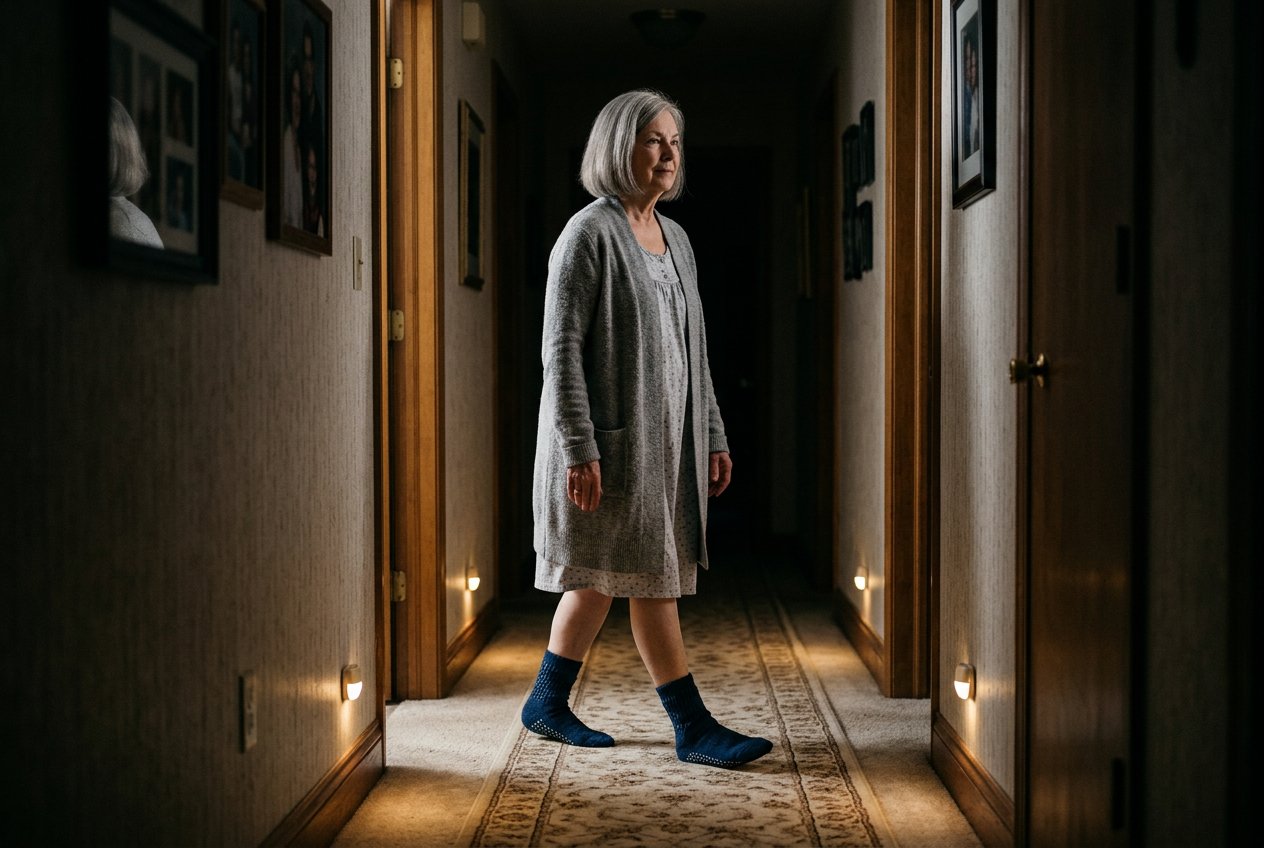
It usually starts with a phone call.
Not a dramatic one. Nobody is screaming. It’s your mother, or your father, or the neighbor across the street, and they’re calling a little later than usual. Their voice is calm, maybe a little too calm, and somewhere around the second sentence they say the words that change the way you think about everything:
“Now, don’t worry, but…”
Maybe they slipped getting out of the shower. Maybe they missed the last step in the dark. Maybe they got up to use the bathroom in the middle of the night, didn’t want to turn on the big overhead light and wake anybody, and the next thing they knew, they were on the hallway carpet trying to figure out how to get back up.
And maybe they were lucky. Maybe it was just a bruise and a scare.
But you hang up that phone a different person. Because now you know something you didn’t let yourself think about before: the person you love is living alone with risks you can’t see, at hours when nobody is watching.
If you’ve had that call, you know exactly the feeling I’m describing. If you haven’t had it yet, I wrote this report so you can do something before you do.
And if you’re the one living on your own, reading this on your tablet with your coffee, proud of the fact that you still run your own household, thank you for staying with me. This report is for you, too. Because nothing I’m about to show you is about taking your independence away. It’s about protecting it.
The Number the Government Publishes Every Year (That Most Families Never See)
I want to be careful here, because this is a subject where a lot of companies like to throw around scary numbers they can’t back up. So I’m only going to use figures straight from the U.S. Centers for Disease Control and Prevention, and I’ll tell you exactly where they come from.
According to the CDC:
- Falls are the leading cause of injury for adults ages 65 and older.1
- Over 14 million older adults, about 1 in 4, report falling every year.1
- The age-adjusted fall death rate for older adults rose 21%, from 64.7 per 100,000 in 2018 to 78.4 per 100,000 in 2024.1
Read that second line again. One in four. Think about the older people in your life: your parents, your aunts and uncles, the friends from church, the couple down the street. Statistically, one in every four of them will report a fall this year.
But here’s the part of the CDC’s summary that I find most important, and most hopeful. They describe older adult falls as “common, costly, and preventable.”1
Preventable doesn’t mean every fall can be stopped. Nobody can promise that, and anyone who does is selling you something you shouldn’t buy. But it does mean the odds can be moved. And the CDC itself has published a home checklist showing exactly where many families should start.
The Question on Page Two of the CDC’s Checklist
The CDC publishes a free brochure called Check for Safety: A Home Fall Prevention Checklist for Older Adults, part of its STEADI program (that stands for Stopping Elderly Accidents, Deaths & Injuries).2 It walks through the home room by room: floors, stairs, kitchen, bathroom, bedroom.
And in the bedroom section, there is a question that stopped me cold the first time I read it:
From the CDC’s checklist
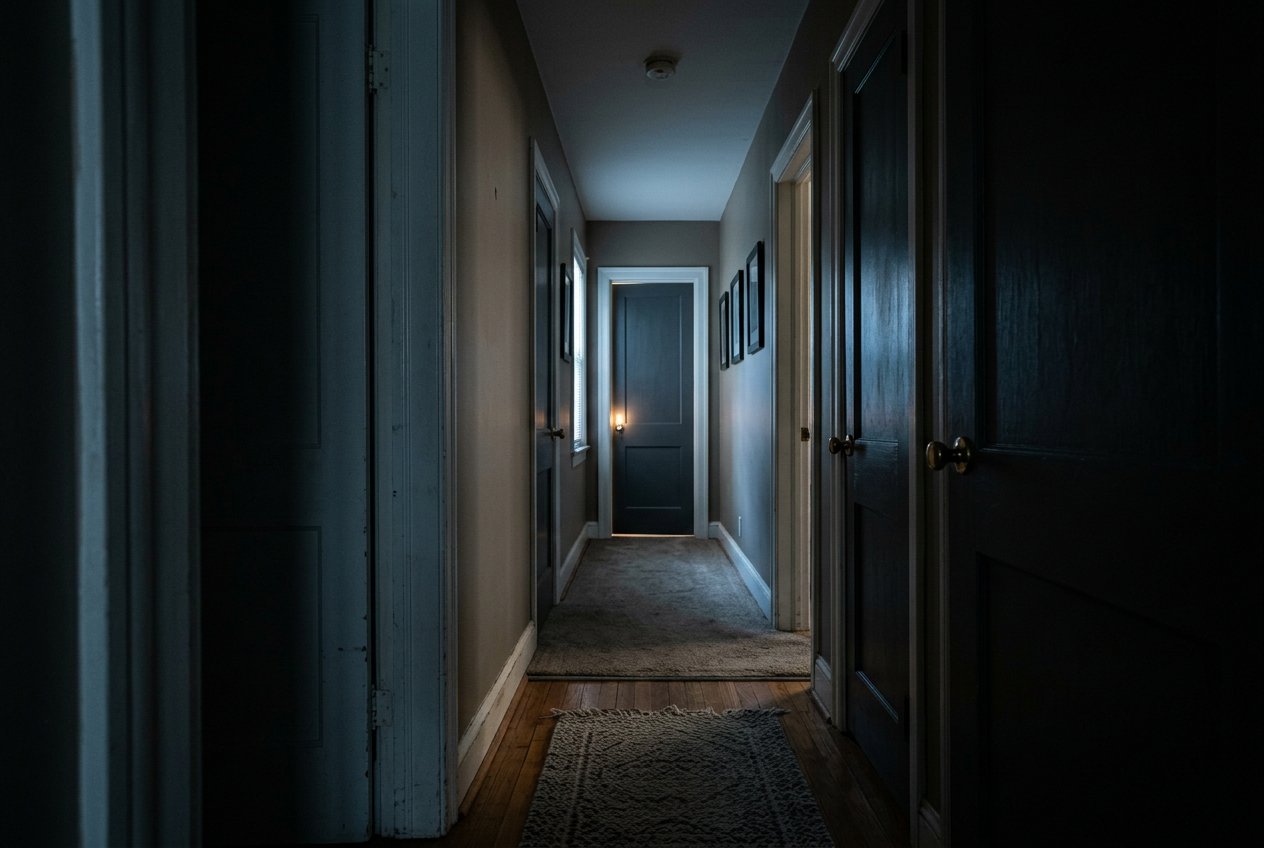
“Is the path from your bed to the bathroom dark?” The recommended fix: “Put in a nightlight so you can see where you’re walking. Some nightlights go on by themselves after dark.”2
That’s it. That’s the fix. Not a renovation. Not a $3,000 stair lift. A light.
Think about what that trip actually looks like at 2 o’clock in the morning. You’ve been asleep. Your eyes haven’t adjusted. You may be a little groggy, a little stiff, maybe a little dizzy from standing up too fast. You may be in a hurry, because when you’ve got to go, you’ve got to go. You don’t want to fumble for a switch on the far wall. You don’t want to flood the room with a harsh overhead light and wake your spouse, or wake yourself up so much you can’t get back to sleep.
So you do what millions of people do every single night. You walk it in the dark. From memory. In your socks, on a hardwood floor, past the edge of a rug you’ve walked past ten thousand times.
Nine hundred and ninety-nine nights out of a thousand, nothing happens.
The problem is night one thousand.
“I Don’t Need All That Stuff.” (Why Proud People Skip the Simple Fixes)
Here’s something anyone who has had this conversation will recognize. The people most at risk are often the least likely to do anything about it. Not because they’re careless. Because they’re proud. And honestly? Good for them.
This is a generation that raised families, built careers, fixed their own cars and paid off their own mortgages. They don’t want to be fussed over. They don’t want a big plastic box on the wall that announces to every visitor, “An old person lives here.” They definitely don’t want another monthly bill.
And when their grown kids show up with a brochure for an assisted living facility, or a catalog of hospital-looking equipment, the conversation tends to go badly. Fast.
“I’m fine.”
“I’ve lived in this house for forty years.”
“I don’t need all that stuff.”
I get it. I’d say the same thing. Which is exactly why the approach I’m going to show you is different. It doesn’t look medical. It doesn’t require a contract, a technician or a Wi-Fi password. Most of it sticks on, plugs in, or slips on in under a minute. And several pieces are honestly just nice to have, the kind of thing a person would happily use even if safety never crossed their mind.
The Three Moments That Worry Families Most
When you strip away all the noise, most families are worried about three specific moments. Not abstract “aging” in general. Three concrete situations:
Moment #1: The dark walk
The trip from bed to bathroom, or from the couch to the kitchen after the sun goes down, or from the car to the front door on a winter evening. Poor light, tired eyes, familiar routes walked on autopilot.
Moment #2: The slippery step
Smooth floors, bare feet or plain socks, a bathroom tile that’s a little damp. The CDC’s own tips include advice on footwear and on making bathroom floors less slippery.2
Moment #3: The call nobody hears
This is the one that keeps adult children awake. Dad needs help, but Mom is in the garden. Grandma needs something, but the caregiver is in the kitchen with the dishwasher running. Somebody is uneasy about a stranger at the door, or in a parking lot, and wants attention right now. They call out, and nobody hears.
Three moments. And as it turns out, each one has a small, inexpensive, almost embarrassingly simple tool that helps.
What I Discovered When I Went Looking for a “Simple” Solution
When you start looking into this, you tend to hit the same two walls.
Wall #1: The big, expensive systems. Some of these are genuinely excellent, and I’ll talk about monitored medical alert services later in this report, because for some people they’re exactly the right call. But they usually involve a monthly subscription, a setup process, and a commitment that a lot of independent seniors just aren’t ready for yet.
Wall #2: The endless scavenger hunt. You go online looking for “night lights for seniors” and get forty thousand results. Then you look for non-slip socks. Then a call bell. Then a personal alarm. Four different searches, four different sellers, four different deliveries, four different sets of reviews to read, and by the time you’re done you’ve spent an evening and still aren’t sure you picked the right ones.
What I wanted was something in between. A single box that covered the basics, that looked like a thoughtful gift instead of a medical delivery, that cost less than a nice dinner out, and that a person could set up themselves on a Tuesday afternoon.
I couldn’t find it packaged the way I wanted. So we put it together ourselves.
We call it Senior Helper.
Inside the Box: Four Small Tools for the Moments That Matter
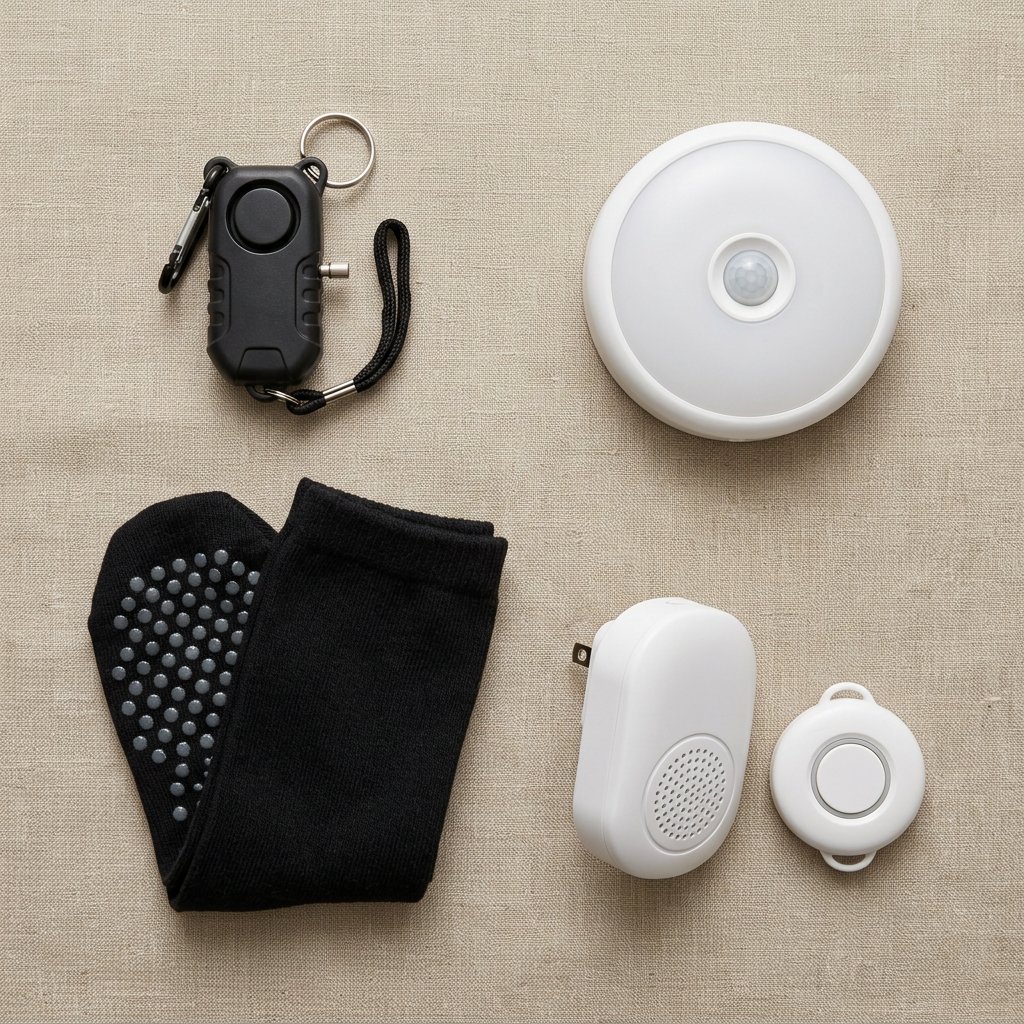
Every Senior Helper kit starts with the same four core pieces. We call this the Essentials kit, and it was built around those three moments: the dark walk, the slippery step, and the call nobody hears.
1. The Motion-Sensor Night Light: “The Hallway Lights Itself”
This is the piece I’d set up first, and it’s the one that answers the CDC’s question directly.
It’s a slim, round, warm-white LED light that sticks to the wall, so there’s nothing to drill and no outlet required. Put it low on the wall along the path from the bed to the bathroom. When it’s dark and it senses motion, it switches on by itself. When you’ve passed and the motion stops, it switches itself back off.
That means:
- No fumbling for a switch in the dark.
- No harsh overhead light blasting you awake or waking your spouse.
- No outlet needed, so it goes exactly where the light is needed, not where the plug happens to be.
- Rechargeable, so there’s no hunting for the right size battery.
The light is a soft, warm tone, the kind that lets you see the floor, the doorframe and the edge of the rug without feeling like you’ve walked into an operating room. Most people stick one by the bed, one in the hall, and one near the bathroom door. You may end up wanting a few more for the stairs, the closet and the kitchen. [TOM: confirm units per kit; the current kit spec is 1 light. Consider a 3-pack for the Gold tier.]
2. Non-Slip Grip Socks: Better Than Plain Socks on Smooth Floors
Let me be straight with you here, because I’d rather earn your trust than oversell a pair of socks.
The CDC’s advice is to wear shoes both inside and outside the house and avoid going barefoot or wearing slippers.2 That’s good advice and we agree with it. Sturdy, well-fitting shoes are the gold standard.
But we all know what really happens. Nobody laces up their walking shoes to go to the bathroom at 2 A.M. Nobody puts on sneakers to pad into the kitchen for a glass of water after a bath. In real life, people are in their socks. And plain socks on hardwood, laminate or tile can be slick.
So for those in-between moments, we include a pair of grip socks with rubberized dots on the sole. They’re soft, comfortable and stretchy, and the grip pattern gives you noticeably more traction than a smooth cotton sock on a smooth floor. They’re not a substitute for good shoes. They’re a much better habit than plain socks.
3. The Wireless Call Button: “Ring Me If You Need Me”
This one solves Moment #3, the call nobody hears, and it’s the one that can change the feel of a household almost overnight.
It’s a small wireless push button plus a plug-in chime receiver. Put the button wherever help might be needed: on the nightstand, beside the recliner, near the bathroom, or on a lanyard. Plug the chime in wherever the helper spends time: the kitchen, the den, the bedroom down the hall. Press the button, and the chime rings in the other room.
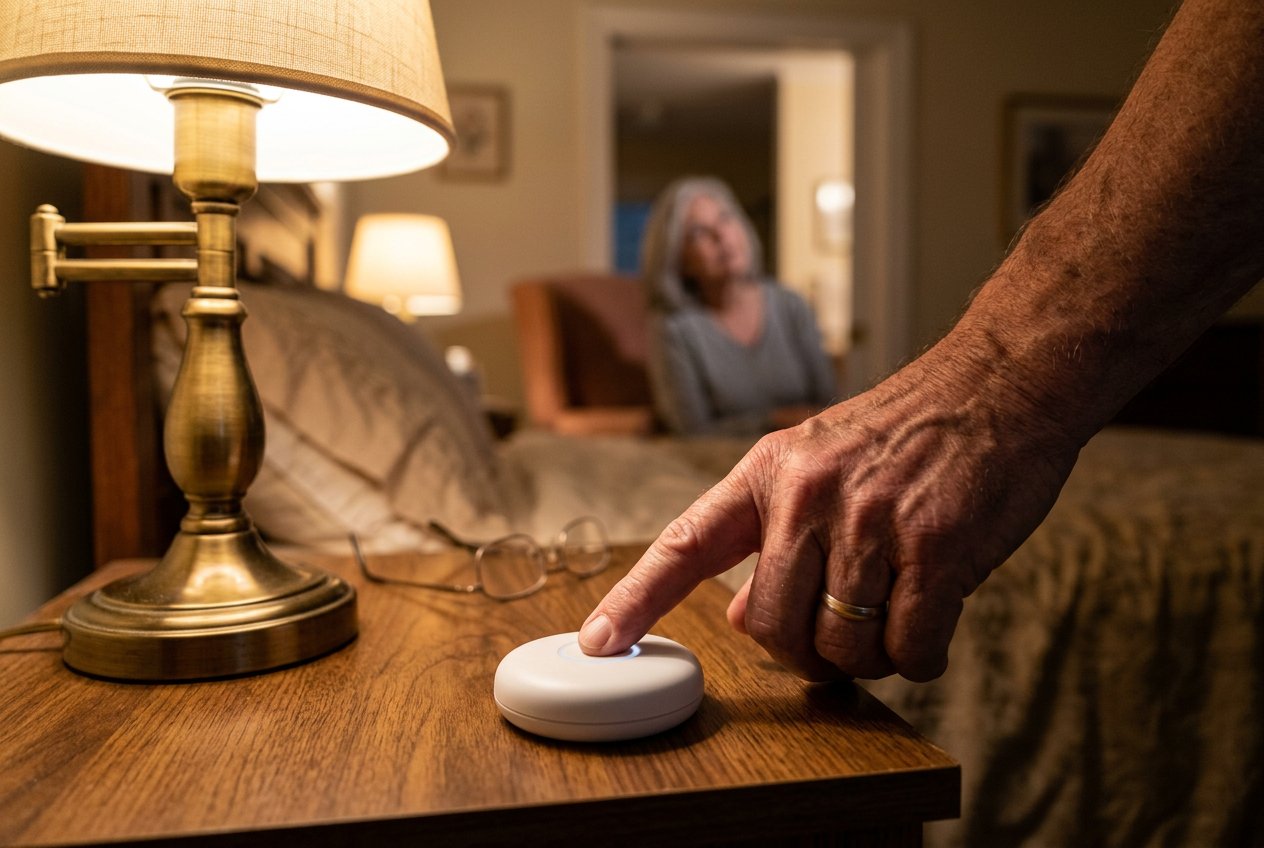
No phone to unlock. No app. No number to dial. Just press.
It’s perfect for:
- A spouse who’s recovering from a procedure and needs to call the other one from the bedroom.
- A parent who has moved in with an adult child and doesn’t want to shout down the stairs.
- A caregiver who wants to be able to step into another room without worrying they’ll miss something.
- Anybody who’s ever called out “Honey?” three times while the dishwasher was running.
Important: what the call button is, and isn’t
The call button is a household chime. It rings inside your home within wireless range of the receiver. It does not call 911, a monitoring center or anyone’s cell phone. For 24/7 emergency response, see the section on monitored medical alert services below.
4. The 130dB Personal Safety Alarm: Loud When You Need to Be
The last core piece is a small keychain alarm. Pull the pin and it lets out a piercing siren rated by the manufacturer at 130 decibels, loud enough to turn heads across a parking lot or bring someone running from the next room.
Clip it to a purse, a walker, a belt loop or a keychain. It’s for those moments when you want attention immediately: an unfamiliar person who’s getting too close, a moment of panic on an evening walk, or a situation at home when you need the neighbors to hear you. Push the pin back in, and it stops.
It’s small enough to forget you’re carrying it, until the moment you’re glad you were.
“What About When She’s Out of the House?”
Once the basics are covered at home, the next question that usually comes up is about everything outside the home. The walk to the mailbox. The trip to the grocery store. The afternoon at the senior center. The car keys that keep going missing.
That’s why we built the Gold kit, which adds two pieces to everything in Essentials. One is practical. One is pure fun.
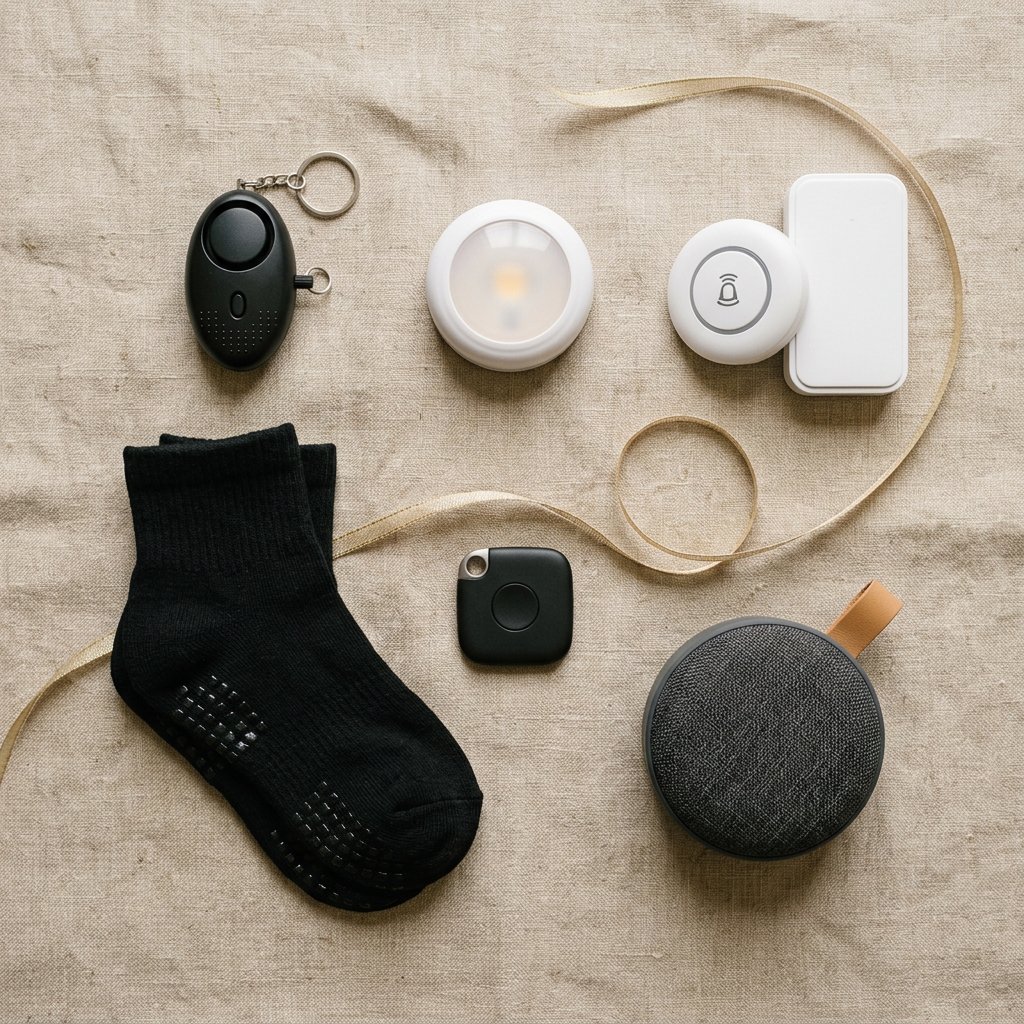
5. The SOS Mini Tracker
This is a small tag, about the size of a large coin, that clips onto keys, slips into a purse or attaches to a bag. It pairs with a smartphone app so items can be located, and it has a button for quick alerts. [TOM: confirm the exact app, pairing method, range and what the SOS button does on this specific model before publishing. Describe only features verified on the unit.]
Families like it for keys that walk off, purses left in the car, and the general peace of mind of a little more connection.
Please read: this is not fall detection
The SOS mini tracker does not detect falls, does not automatically call for help, and is not a monitored emergency device. It is not a substitute for 911 or a medical alert service. If automatic fall detection or 24/7 monitoring is important for your loved one, please see the medical alert section further down.
6. The Bluetooth Speaker: Because Life Should Still Be Fun
I’ll admit this one isn’t a safety device at all. It’s here on purpose.
Something you hear again and again from older adults is that the hardest part of getting older isn’t always the physical stuff. It’s the quiet. The house that used to be loud with kids and dinners and Saturday ball games is now very, very quiet.
So the Gold kit includes a compact wireless speaker that pairs with a phone or tablet. Big, room-filling sound for the old big-band records, the Sunday sermon, the audiobook, the ball game, or the grandkids’ favorite song when they come to visit. It’s small enough to carry from room to room and simple enough to use with one button.
Because the point of staying independent isn’t just to stay safe. It’s to keep enjoying your life.

That’s why Gold is the kit we recommend most, and honestly the one I’d pick for my own family. For $30 more than Essentials, you get two extra pieces that cover both life outside the house and the joy inside it.
“Speak Up, I Can’t Hear the TV.”
There’s one more thing that comes up in almost every household with an older adult, and it’s usually the subject of more friendly arguments than anything else in the house: the volume.
The TV is too loud for one person and too quiet for the other. The phone call with the grandkids is all “What? Say that again?” The dinner conversation at the crowded restaurant turns into a lot of polite nodding.
Now, let me be very clear before I go any further. If you or someone you love is having trouble hearing, the right first step is to talk with a doctor or a licensed hearing professional. Nothing in our kit is a hearing aid, and nothing in our kit is meant to diagnose, treat or make up for hearing loss.
But there’s a whole category of everyday listening that has nothing to do with medicine and everything to do with convenience. Watching TV without cranking it up for the whole house. Listening to a podcast while you putter in the garden. Making the sounds around you a bit louder in a quiet room, the same way reading glasses from the drugstore make the newspaper easier to read.
That’s what the Platinum kit is for.
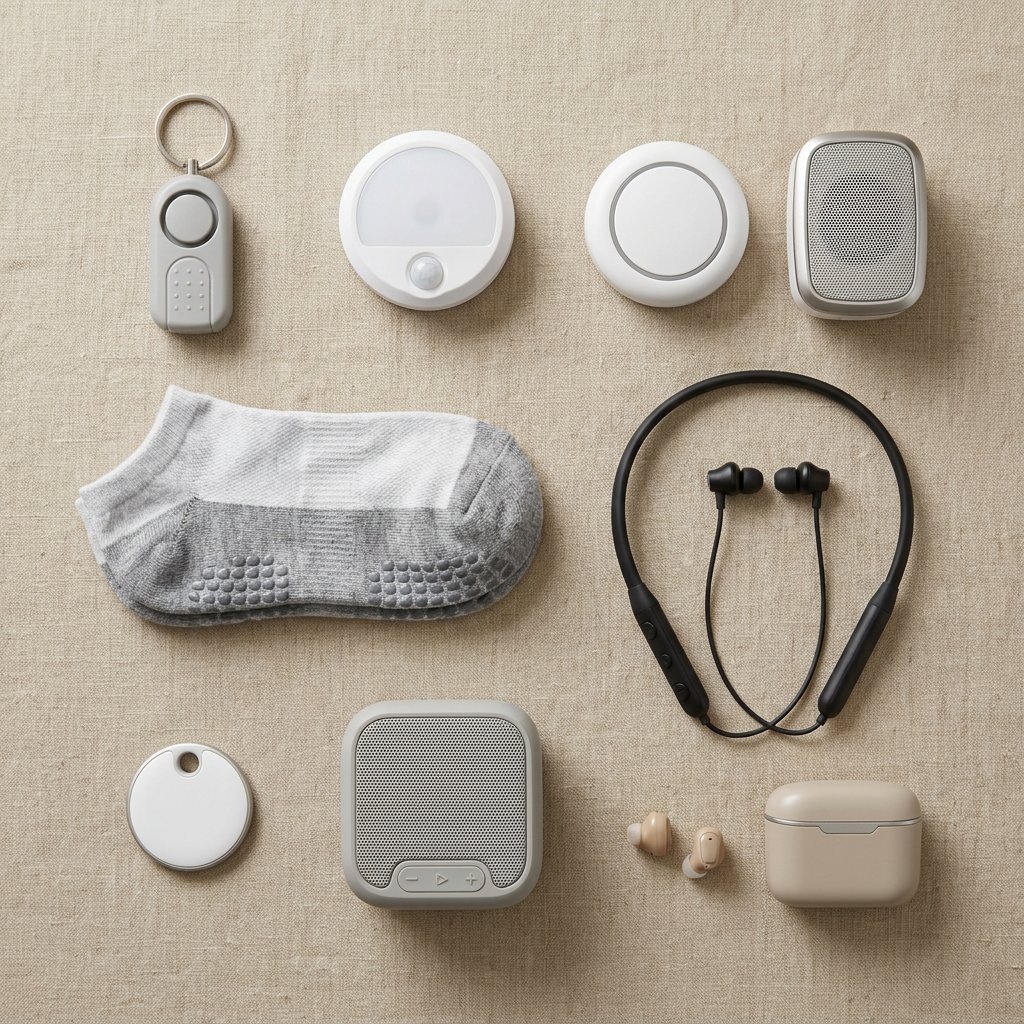
7. Neckband Wireless Headphones
These rest comfortably around the neck with small earbuds on short cords, so there’s nothing heavy squeezing your head and nothing to lose under the couch cushion. Pair them with a phone, a tablet, or a Bluetooth-capable TV and enjoy your shows, music or audiobooks at the volume you like, while the rest of the house enjoys the volume they like. [TOM: confirm TV compatibility wording; many TVs need a Bluetooth transmitter.]

8. The Personal Sound Amplifier
This small in-ear device makes the sounds around you louder, which some people like in quiet, everyday situations such as a one-on-one chat at the kitchen table, birdsong on the porch, or a lecture in a small room. It’s rechargeable and small enough to carry in a pocket.
The honest fine print on the sound amplifier
This is a personal sound amplification product for people with normal hearing who want to make some sounds louder. It is not a hearing aid. It is not intended to diagnose, treat, cure, compensate for or prevent hearing loss or any other medical condition. If you think you may have hearing loss, please see a doctor or licensed hearing professional.
Put it all together, and Platinum is the complete Senior Helper experience: everything for safety and peace of mind at home, everything for getting around outside it, and everything for keeping the TV, the music and the conversation enjoyable.
Picture a Week With Senior Helper
Let me paint a picture. This is an illustrative example, not a real customer, but if you’ve got an older parent, I think you’ll recognize her.
Call her Margaret. She’s 79, a retired schoolteacher, and she’s lived in the same two-story house for 41 years. Her daughter lives two hours away and calls every Sunday. Lately, those calls have had a little edge of worry to them.
Monday. The Senior Helper box arrives. Margaret’s daughter set it up as a gift, so it’s a surprise. Margaret opens it at the kitchen table and, to her own surprise, doesn’t feel insulted. Nothing in it looks like a hospital. It looks like a thoughtful little care package.
Tuesday. Her neighbor helps her stick the night light on the wall between the bedroom and the bathroom. It takes about thirty seconds. That night, when Margaret gets up at 2:40 A.M., the hallway glows softly as she walks past and switches itself off once she’s back in bed. She doesn’t think about it at all, which is exactly the point.
Wednesday. She puts on the grip socks after her bath instead of the old fuzzy slippers. She’s still planning to buy a decent pair of house shoes, like her daughter keeps reminding her, but this is a step in the right direction.
Thursday. Her husband passed a few years back, but her grandson is staying with her for a week while he looks for an apartment. She puts the call button on her nightstand and the chime in the guest room. “Ring me if you need me, Gran.” She never does. But she likes knowing she could.
Friday. The keychain alarm goes on the zipper of her purse. Her daughter feels better about her evening bridge club already.
Saturday. The speaker comes out. Frank Sinatra fills the kitchen while she bakes, louder and clearer than her old radio ever managed.
Sunday. The phone call with her daughter is different. Lighter. Less worried. They actually talk about the grandkids instead of the stairs.
Nothing dramatic happened that week. And that’s the whole point.
Why We Kept Senior Helper So Simple (and So Affordable)
When we started building these kits, there was a lot of pressure to make them fancier. Add a Wi-Fi hub. Add an app for everything. Add a monthly plan.
We said no, for three reasons.
Reason #1: Simple gets used
The best safety tool in the world is useless if it sits in a drawer because it was too confusing to set up. Every item in Senior Helper sticks on, plugs in, clips on or slips on. If you can change a light bulb, you can set up the kit.
Reason #2: No monthly bill
Many older adults are on a fixed income, and every new subscription is one more thing to keep track of. Senior Helper is a one-time purchase. You buy it, it’s yours. There’s nothing to renew and nothing to cancel.
Reason #3: It should feel like a gift, not a diagnosis
There’s a big difference between handing your mother a box that says “You’re getting old” and handing her one that says “I love you and I want you to stay in this house as long as you want to.” We designed every piece to fit into a normal home without looking clinical.

What Families Could Expect: Illustrative Examples
Senior Helper is a new product, so rather than show you reviews we can’t verify yet, here are a few illustrative examples of how different households might use the kit. They are not real customer reviews. [TOM: replace with real, verified customer reviews once available, with permission. Do not invent names, photos or quotes.]
“My dad refused anything that looked like medical equipment. The night lights and the speaker he accepted right away. The call button lives on his recliner now.”
“My husband is recovering from knee surgery. Instead of yelling down the stairs, he presses the button and I hear the chime in the kitchen. It’s saved our marriage, ha.”
“I bought Gold for myself. I like walking to the park in the evening and the alarm on my keychain makes me feel more confident. The speaker was a nice bonus.”
Choose Your Senior Helper Kit
Every kit is a one-time purchase with no subscription. Each tier includes everything in the tier before it. Here’s exactly what you get:
Essentials
- Motion-sensor stick-on night light (rechargeable)
- Non-slip grip socks
- Wireless call button + plug-in chime
- 130dB personal safety keychain alarm
Gold
- Everything in Essentials, plus:
- SOS mini tracker
- Compact Bluetooth speaker
Platinum
- Everything in Gold, plus:
- Neckband wireless headphones
- In-ear personal sound amplifier (not a hearing aid)
| What’s included | Essentials | Gold | Platinum |
|---|---|---|---|
| Motion-sensor night light | ✔ | ✔ | ✔ |
| Non-slip grip socks | ✔ | ✔ | ✔ |
| Wireless call button + chime | ✔ | ✔ | ✔ |
| 130dB safety keychain alarm | ✔ | ✔ | ✔ |
| SOS mini tracker (not fall detection) | – | ✔ | ✔ |
| Bluetooth speaker | – | ✔ | ✔ |
| Neckband wireless headphones | – | – | ✔ |
| Personal sound amplifier | – | – | ✔ |
| Price | $49.99 | $79.99 | $129.99 |
Shipping: orders typically arrive in about 4–9 business days after they ship. [TOM: confirm shipping price (free or flat rate), processing time, and that items ship from an international warehouse; disclose that if so.]
Our Promise to You
We want you to feel good about this purchase. If you’re not satisfied, contact us within [XX] days of delivery for [a full refund / a refund of the product price / an exchange]. [TOM: fill in exact window, whether return shipping is required and who pays it, condition requirements, and how to start a return. Must match the store refund policy word for word.]
Questions before you buy? Email [SUPPORT EMAIL] or call [SUPPORT PHONE], [HOURS, PT].
Would a Monitored Medical Alert Service Be Better for Your Family?
I promised I’d be honest with you, so here it is: for some people, Senior Helper isn’t enough on its own.
Our kit is designed to make everyday moments safer and easier: lighting the path, improving grip, ringing for help inside the home, and getting attention fast. What it doesn’t do is connect anyone to a 24/7 response center, and nothing in the kit offers automatic fall detection.
If your loved one lives completely alone, has fallen before, has a medical condition their doctor is watching closely, or simply wants the reassurance of a trained person answering when they press a button, a monitored medical alert service may be the better fit, or the perfect partner to Senior Helper.
Many of these services offer a wearable button that connects to a live monitoring center, and some offer optional automatic fall detection for an added monthly fee. Features, pricing and coverage vary by provider, so compare carefully.
Want to compare medical alert options?
We’ve partnered with [PARTNER NAME] to help families explore monitored medical alert plans. [TOM: insert partner name, required affiliate/partner disclosure, and confirm the partner’s fall-detection claims are their own.]
Setting Up Your Kit Takes About 10 Minutes
Here’s the whole process, start to finish:
- Charge the night light using the included cable. While it charges, walk the route from the bed to the bathroom with the lights off and notice the darkest spot.
- Stick the night light low on the wall at that spot, about knee height, so it lights the floor rather than shining in your eyes.
- Plug in the chime in the room where the helper spends the most time, and put the call button where it’s needed. Press it once to test.
- Clip the alarm to a purse, keychain or walker. Pull the pin once to hear how loud it is (warn the dog first), then push it back in.
- Put the grip socks by the bed or the bathtub, so they’re the easy choice.
- Gold and Platinum: pair the speaker, tracker and headphones with a phone or tablet using the instructions in the box. A grandchild is usually happy to help.
While you’re at it, the CDC’s checklist suggests a few other free, easy fixes worth doing the same afternoon: remove or secure throw rugs, keep floors clear of papers, shoes and cords, and keep often-used items within easy reach.2 The CDC also suggests talking with your doctor or pharmacist about medications that might make you dizzy or sleepy, and having your eyes checked regularly.2
Frequently Asked Questions
Is there a monthly fee?
No. Senior Helper is a one-time purchase. There is no subscription and nothing to cancel.
Does any of this call 911 or a monitoring center?
No. The call button rings a chime inside your home, the keychain alarm makes a loud sound, and the tracker works with a smartphone app. None of them contact 911 or a monitoring center. For that, see our medical alert section above.
Does the SOS tracker detect falls?
No. It does not detect falls and does not automatically call anyone. If fall detection matters to you, look at a monitored medical alert service with that feature.
Is the sound amplifier a hearing aid?
No. It is a personal sound amplification product for people with normal hearing who want to make some sounds louder. It is not intended to diagnose, treat or compensate for hearing loss. If you’re concerned about your hearing, please see a doctor or licensed hearing professional.
Will it prevent falls?
No product can promise that. Senior Helper is designed to address some common everyday hazards that the CDC’s own home checklist calls out, like dark paths at night, and to make it easier to get someone’s attention. Talk to a healthcare provider about your personal fall risk.
Do I need Wi-Fi or a smartphone?
Not for the Essentials kit. The night light, socks, call button and alarm all work on their own. The tracker, speaker and headphones in Gold and Platinum pair with a phone or tablet over Bluetooth.
What batteries do the items use?
The night light is rechargeable. The keychain alarm and the call button use small batteries. [TOM: confirm battery types, whether included, and charging cables for each item.]
How long does shipping take?
Orders typically arrive in about 4–9 business days after they ship. You’ll get tracking by email. [TOM: confirm processing time and shipping cost.]
What sizes do the grip socks come in?
[TOM: confirm the sizing from the supplier spec before publishing.]
Can I send it as a gift to my parent’s address?
Yes. Just enter their address as the shipping address at checkout. [TOM: confirm whether gift notes or price-free packing slips are available.]
Which kit should I pick?
If you mainly want safer nights at home, Essentials covers it. If your loved one still gets out and about and enjoys music, Gold is our best value. If TV volume and listening comfort are a daily topic in the house, Platinum adds headphones and a personal sound amplifier.
What if I’m not happy with it?
See the Senior Helper Guarantee above. [TOM: final refund terms.]
The Best Time to Do This Is Before the Phone Call
Let’s go back to where we started. That phone call. “Now, don’t worry, but…”
I can’t promise you’ll never get one. Nobody can. But I can tell you that the families who feel best about how they handled a parent’s later years often have one thing in common: they did the simple things early, while everyone was still healthy, still independent and still in a good mood about it.
They lit the hallway. They swapped the slick socks. They put a button by the bed. They made it easier to be heard. And then they got back to the good stuff: Sunday dinners, ball games, and phone calls about the grandkids instead of the stairs.
Senior Helper costs less than a single nice dinner out. It sets up in about ten minutes. And it might just make the next phone call a happy one.
Pick the kit that fits your family below.
To your independence, and your peace of mind,
[AUTHOR NAME]
Senior Helper
P.S. If you’re buying for a parent who “doesn’t need all that stuff,” try this: don’t call it a safety kit. Call it what it is, a care package from someone who loves them. Start with the night light. It’s hard to argue with a hallway that lights itself.
P.P.S. If your loved one lives alone and has fallen before, please also look at a monitored medical alert service with fall detection. Senior Helper is a great everyday companion to one, but it’s not a replacement. Compare medical alert plans here.